Saturday, May 23, 2020

Why Jawaharlal Nehru was made first PM of india.


THE TRUTH OF FIRST INDIAN PRIME MINISTER


Maulana Azad was elected Congress president within the Ramgarh Session in 1940. As there were various factors like world war II, Quit India Movement and most of the Congress leaders being in jails, Azad continued to be the Congress president until April 1946.

As the war was coming to an end, it had been becoming clear that India’s freedom isn't very far. it absolutely was also very clear that the Congress president, shall be invited to create the interim government at the Centre — because of the amount of seats within the Central Assembly the Congress had won in 1946 elections.

Once the election for the post of the Congress president was announced, Maulana Azad expressed his desire for the re-election. Maulana writes in his autobiography,


“The question normally arose that there should be the fresh Congress elections
and a replacement President chosen. As soon as this was mooted within the Press,
a general demand arose that I should be selected President for an additional term….” This “agonised Azad’s close friend and colleague Jawaharlal who had his own selfish expectations.” However, on 20 April 1946, Gandhiji made his choice known within the favour of Nehru. Despite Gandhiji’s open support for statesman, the Congress party overwhelmingly wanted Sardar Vallabhbhai Patel because the president and consequently the primary Prime Minister of India, because Patel was considered “a great executive, organizer and leader” along with his feet firmly on the bottom. At that point only the Pradesh Congress Committees could nominate and elect the Congress president. And April 29, 1946 was the last date for the nominations for the post of the Congress president, and thereby the primary Prime Minister of India..

A record of the Congress party documents shows that despite of Gandhiji having made his choice known, 12 out of 15 Pradesh Congress Committees nominated Sardar Patel. The three remain abstained from nomination process.

Thus, no Pradesh Congress Committee, the sole legitimate body to nominate and elect the President, nominated Jawaharlal Nehru.
However, Nehru was proposed by some working committee members who had no authority to try to to so. After this, efforts began to steer Sardar Patel to withdraw in favour of Jawaharlal. To resolve the difficulty, Gandhi said to Nehru:
“No PCC has advocate your name…only [a few members of] the working committee has.”

This remark of Gandhiji was met by Jawaharlal with “complete silence”. Once Gandhiji was informed that “Jawaharlal won't take the second place”, he asked Patel to withdraw. Rajendra Prasad lamented that Gandhiji “had once more sacrificed his trusted lieutenant for the sake of the “glamorous Nehru” and further feared that “Nehru would follow the British ways"    


When Rajendra Prasad was using the phrase “once again”, he indeed was concerning the denial of Congress president-ship to Patel in 1929, 1937 and 1946 in preference to Nehru; and always at the last moment.
Patel accepted to have the second position because of two reasons: firstly, for Patel, post or position was immaterial; and secondly, Nehru was keen that “either he would take  spot one within the government or stay out. Vallabhbhai also reckoned that whereas office was likely to moderate Nehru, rejection would drive him into opposition. Patel shrank from precipitating such an outcome, which might bitterly divide India.”

Maulana Azad, who had issued an announcement on 26 April 1946, three days before the last date of nomination, to elect Nehru as Congress president, wrote in his autobiography, published posthumously in 1959:
“After weighing the pros and cons I came to the conclusion that the election of Sardar Patel wouldn't be desirable within the existing circumstances. Taking all facts into consideration it perceived me that Jawaharlal should be the new President….
“I acted in keeping with my best judgment but the way things have shaped since then has made to grasp that this was perhaps the best blunder of my political life. …It was a big mistake that I didn't support Sardar Patel. … He would have not committed the error of Jawaharlal… I can never forgive myself once I think that if I had not committed these mistakes, perhaps the history of the last ten years would are different.”

Michael Brecher, one amongst the foremost sympathetic biographers of Nehru, writes:
“In accordance with the time-honoured practice of rotating the Presidency, Patel was in line for the post. Fifteen years had elapsed since patel presided over the Karachi session whereas Nehru had presided at Lucknow and Ferozpur in 1936 and 1937. Moreover, Patel was the overwhelming choice of the Provincial Congress Committees…. Nehru’s ‘election’ was thanks to Gandhi’s intervention. Patel was persuaded to step down….
“If Gandhi had not intervened, Patel would are the primary actual Premier of India, in 1946-7…. The Sardar was ‘robbed of the prize’ and it rankled deeply.”
Looking back in any respect those tumultuous years C. Rajagopalachari, who had all the explanations to be angry, and uncharitable to Sardar Patel because it had been Patel who deprived Rajaji the primary President ship of India, wrote in Bhawan’s Journal in 1972 (almost 22 years after Patel’s death):
“Undoubtedly it'd are better if Nehru had been asked to be the minister and Patel made the Prime Minister. I too fell into the error of believing that Jawaharlal was the more enlightened person of the two… This was a wrong notion but it had been the prevailing prejudice.”

Prof. Makkhan Lal is Founder Director of Delhi Institute of Heritage Research and Management and currently Distinguished Fellow at Vivekananda International Foundation.

Whatever you conclude it as Gandhi stubbornness Or overrated national leader ,the irresponsible decision taken by this overrated leader had cost India a huge loss in variety of POK, Chinese invasion, Nepotism, Failure of policies etc which might never be compensated.


Sources
Maulana Abul Kalam Azad, 1959, India Wins Freedom
Rajmohan Gandhi, 1991, Patel: A Life
Durga Das, 1969, India From Curzon to Nehru and After
Brecher, 1959, Nehru: A Political Biography
C. Rajagopalachari, in Swarajya
The Print article (In Patel vs Nehru saga, remember that India’s first PM wasn’t elected unanimously


:


Thursday, February 6, 2020

Truth behind the death of Lal Bahadur Shastri

Tuesday, January 21, 2020

Secularism and Constitution of India

Secularism and Constitution of India

From an age long discussion secularism word have been highlighted frequently on media ,social media sites ,sometimes word secularism word from the Constitution of India is taken as the bases understanding what is correct and what is wrong happening in the country. In this article we will have a detailed study about this word (secular), who introduced it in Indian Constitution, Dr Bhim Rao Ambedkar views on secularism etc.


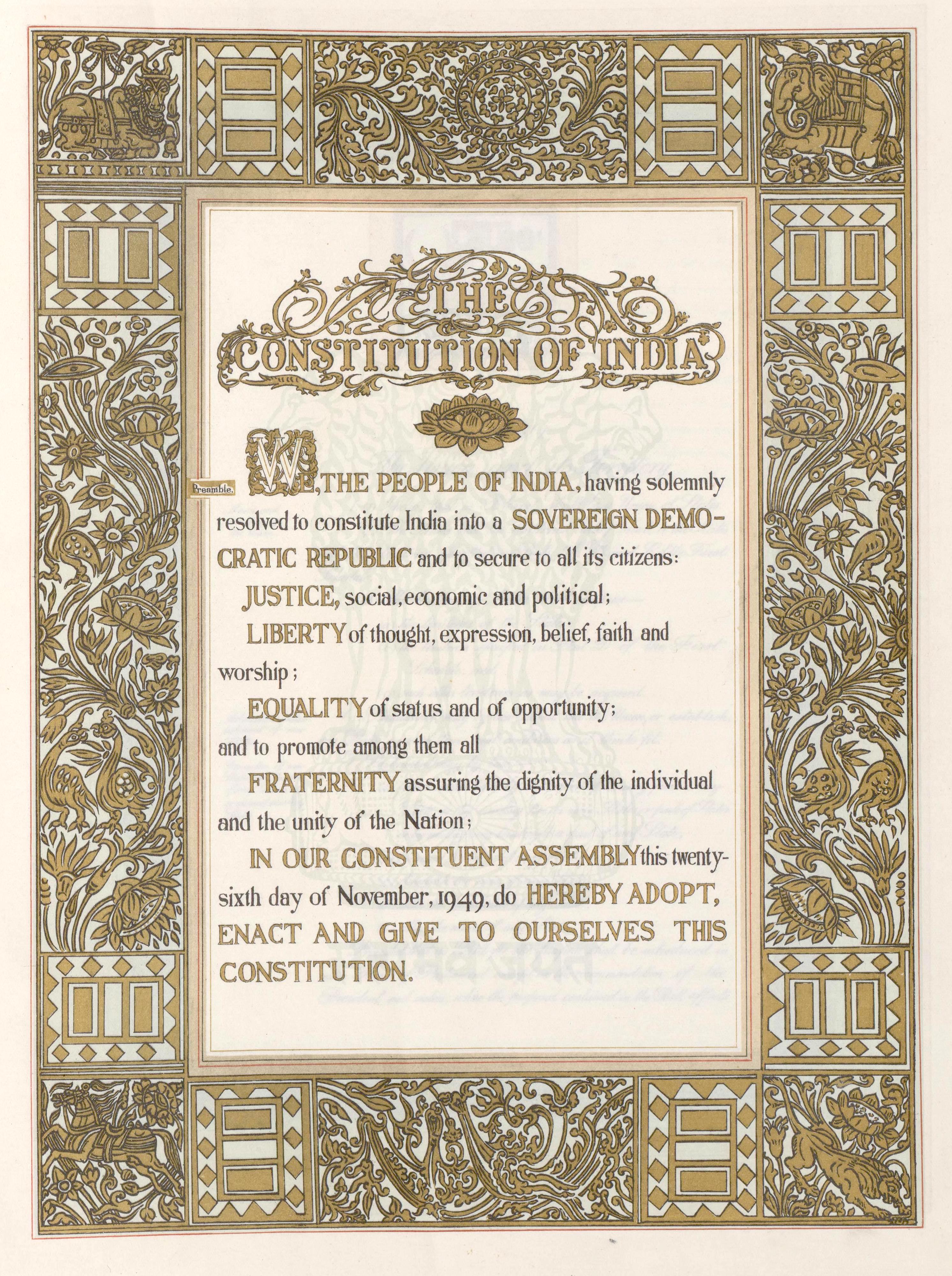
But before moving forward have a look on Preamble of Indian constitution which came in existence  in 1950
Image result for preamble of india in hindi

Preamble of Indian constitution in 1950(It doesn't have word secular in it.)

The preamble specifies the source of authority and the system of a government, the objectives to be attained by a political system and the date of the adoption and enactment of the Constitution. Though the Preamble is not enforceable in any court of law and generally, not considered a part of the Constitution, it provides a principle key understanding and interpretation of the Constitution; it has, therefore, been described as the soul of a Constitution. In case of any doubt the Supreme Court has referred to the Preamble to elucidate various aspects of the Constitution.  Now the question arises why the writer of constitution Dr. Bhim Rao Ambedkar didn't placed word secularism in it ,even Indian constitution give full access to practice every religion with its full freedom why DR Ambedkar do this??


 Dr B.R. Ambedkar was so opposed to the inclusion of word “secular” in the Constitution of India. The text of the Constituent Assembly Debates has been cited to argue that when Professor K.T. Shah proposed this inclusion of a word “secular”, Ambedkar also opposed this amendment. The politically motivated suggestion behind this development is that Ambedkar was not a supporter of a secular Constitution for India. According to him secularism can be a policy of a political party but not of a country.


The context of this word’s insertion into the Constitution is a reason enough to show it illegitimate. “Secular” was made a part of the Constitution’s Preamble by a infamous 42nd Amendment enacted during the Emergency. Then Prime Minister Indira Gandhi set up a committee in 1976 under the Chairmanship of the Minister of External Affairs of that time Swaran Singh. When most of the opposition leaders were in jail, the amendment severely curtailed the fundamental rights of Indian citizens and also imposed a number of fundamental duties upon them. Much of the 42nd Amendment has been rolled back through court verdicts and succeeding legislation in parliament, but the word secular remains in the draft.

Below is the Preamble of constitution after 42 constitution Amendment in 1976.
Image result for preamble of india after1976

Now the question arises why Indira Gandhi was in so much hurry to add this word in constitution, and when the most of the influential leader of oppositions were jail no one to oppose in Lok Sabha and Rajya Sabha ,the bill passed ,was it possible if this bill had a proper scrutiny in parliament if this was not an emergency?

Were this much of Government policies would have been opposed on the name of secularism??Wouldn't India have been a better place to live????


Read sensational and famous article--- Boss or Gandhi


Saturday, January 18, 2020

Boss or Gandhi


Boss or Gandhi


People who are so constrained by their mental trauma to such a level that they ignore the facts and truth are not to be benefited by this article .This is a factual article without any imagination but pure truth so evaluate after reading and share your views after that......
 I wish to  actualise one of the most important and one of  the most controversial question that "who was the real hero of Indian independence".
It's been 70+ years but still we are confused about whom to give this title (if you don't have enough confusion about this matter make sure you through some history books other then NCERT).

In the present scenario a random look on Indian historians or history leaders can conclude you to the thought that it must be Gandhi as we have been told  from school days . Even i am a great fan of Gandhi his efforts for uniting the country are still unmatched till date but overrated on role of county freedom. Some of the readers must be feeling offended by my above statement. But after reading the text below they will be able to forgive me.

This startling conversation was first published by a famous Organisation, Institute of Historical Review by an author Ranjan Borra in 1982.

 Clement Attlee( British PM who had given us independence by withdrawing British rule from India) to governor of Bengal .

"My direct question to Attlee was that since Gandhi's Quit India movement had tapered off quite some time ago and in 1947 no such new compelling situation had arisen that would necessitate a hasty British departure, why did they had to leave?.

"In his reply Attlee cited several reasons for departure, the principal among them was being the erosion of loyalty to the British crown among the Indian army and Navy personnel as a result of the military activities of Netaji subhash chandra boss," Justice Chakraborthy says.

That's not all and Chakraborthy adds, "Toward the end of our discussion I asked Attlee what was the extent of Gandhi's influence upon the British decision to quit India. Hearing this question, 
Attlee's lips became twisted in a sarcastic smile as he slowly chewed out the word, m-i-n-i-m-a-l!"

The above content is a bit in understanding who was what, there are hundred of facts which have been hidden from us  or you can say were made hidden from the country just to glorify someone .The reason for this fraud could be introspective .....


You can verify your doubt by reading the following book by General GD Bakshi Boss or Gandhi
  Also read article on topic  ---Secularism and constitution of india

Indo-Pak Relations: A Complex and Evolving Dynamic

The relationship between India and Pakistan is one of the most complex and delicate in South Asia, shaped by a shared history, political con...